
Weekly Planning for Managers: Choose 3 Priorities and Protect Your Time
You start Monday with a clear idea of what you want to accomplish. Then someone calls out. A customer needs help. Your boss requests an update. A team member stops by with “one quick question.”
By Friday, you have worked hard, handled dozens of problems, and barely touched the work you intended to finish.
For frontline and mid-level managers, that pattern is familiar. Your job includes responding to people and keeping the operation moving. But when every request determines your next move, important work can keep slipping into next week.\
Weekly planning for managers means choosing three meaningful outcomes, making room for them in your calendar, and leaving enough flexibility to handle the unexpected.
Here is a practical routine you can use before your next week begins.
1. Audit Your Commitments Before Adding More
Start by looking at what already has a claim on your time.
Review your calendar, upcoming deadlines, staffing needs, unfinished commitments, and follow-ups you owe other people. Include work that requires preparation. A Wednesday meeting may also require an hour of preparation on Tuesday.
Ask yourself:
What must happen this week?
What have I already promised?
Where will my team need my support?
Which unfinished items still matter?
What can I delegate, delay, shorten, or remove?
This step keeps you from planning a full week of new work on top of a week that is already full.
Suppose you have several meetings, two employees in training, and a major delivery arriving Thursday. Those commitments affect what you can reasonably accomplish. Build your plan around the capacity you actually have.
Watch for work that keeps rolling forward
An item that appears on your list every week needs a decision.
Does it need protected time? A smaller scope? A different owner? Or has it become less important?
Carrying it forward without making that decision keeps the list long without moving the work.
2. Choose Three Weekly Priorities
Once you understand your commitments, choose three outcomes that deserve your attention.
Three is a useful planning limit because it forces a choice. You will still complete routine tasks, attend meetings, and respond to problems. Your three priorities identify the results you want to protect within that workload.
Use these questions to narrow the list:
What will help my team perform better?
What will prevent or resolve a recurring problem?
What commitment would create the greatest consequence if it slipped?
Look for a mix that fits your situation. Some weeks will center on staffing and execution. Others may require coaching, preparation, or improving a process.
Write priorities as outcomes
“Work on scheduling” is difficult to finish because it does not define what finished means.
“Publish next week’s schedule by Thursday at noon, with every shift covered” gives you a clear target.
Compare these examples:
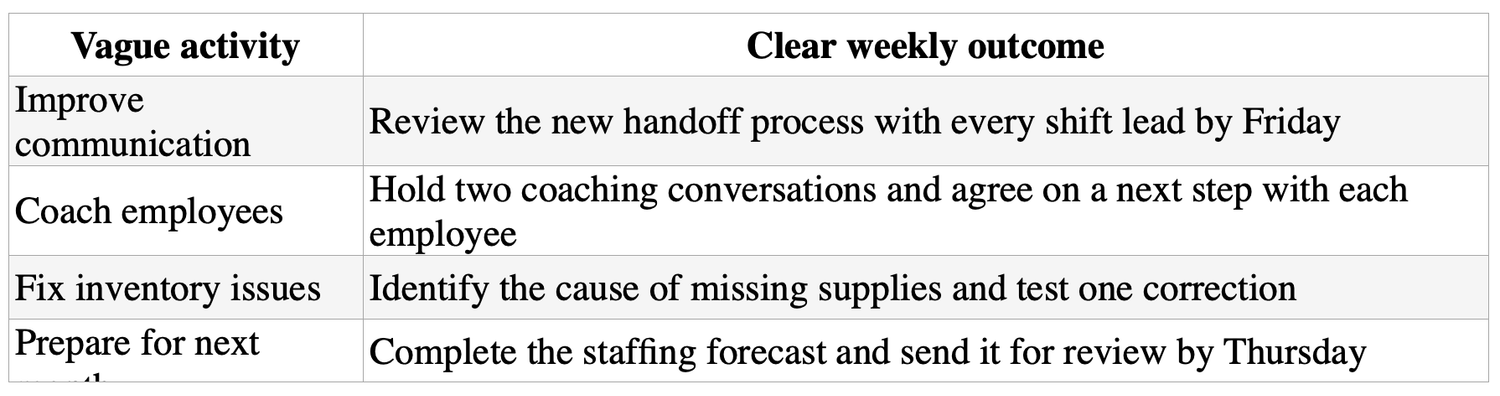
A strong priority tells you what needs to be different by the end of the week.
If an outcome is too large to finish, choose a meaningful milestone. “Finish the training program” might become “Complete the first two training checklists and test them with one new employee.”
3. Protect Time Before the Week Fills Up
A priority written on a list still needs a place in your week.
For each outcome, identify the next action and reserve time for it. Make the calendar entry specific enough that you can begin without reconsidering the whole project.
Instead of “Focus time,” write:
Draft next week’s staffing schedule.
Review service callbacks and identify repeat issues.
Prepare for coaching conversation with shift lead.
Write the first version of the opening checklist.
Choose times that fit the operation. A service manager may have a quieter window after the morning dispatch. A retail manager may need planning time before opening or during a reliable overlap in coverage.
Start with a block you can realistically protect. Thirty useful minutes can move work forward.
Explain how urgent issues should reach you
Your team needs to know how to get help while you are working.
You might say:
“I’m working on next week’s schedule from 9:30 to 10:00. Bring urgent safety or customer issues to me immediately. Please collect routine questions, and I’ll check in at 10:00.”
That gives people a clear expectation and a reliable time to reconnect.
When something interrupts the block, decide whether it needs your attention now. If it does, handle it—and give the displaced work a new place in your calendar.
4. Leave Room for Interruptions
Managers need flexibility because people and operations create work that cannot always be predicted.
Leave some space between commitments and avoid filling every open hour. The right amount depends on your role, staffing, and how much of your day requires an immediate response.
Look at your recent experience:
When do interruptions usually happen?
Which days are hardest to predict?
What issues repeatedly consume more time than expected?
Where would a small amount of open time help?
Build around those patterns.
If Monday mornings regularly require staffing adjustments, use that knowledge. Put work requiring sustained attention in a more dependable window.
When the week has no room for a new request, make a tradeoff explicit: what will move, what can someone else handle, or what can wait?
A Sample Weekly Plan for a Service Manager
Imagine you manage a service team. You oversee daily assignments, respond to customer concerns, and support two developing team leads.
After reviewing your commitments, you choose these three priorities:
Publish next week’s fully covered staffing schedule by Thursday at noon.
Complete coaching conversations with both team leads, each with an agreed next step.
Review repeat service calls and select one process change to test.
Your calendar could look like this:
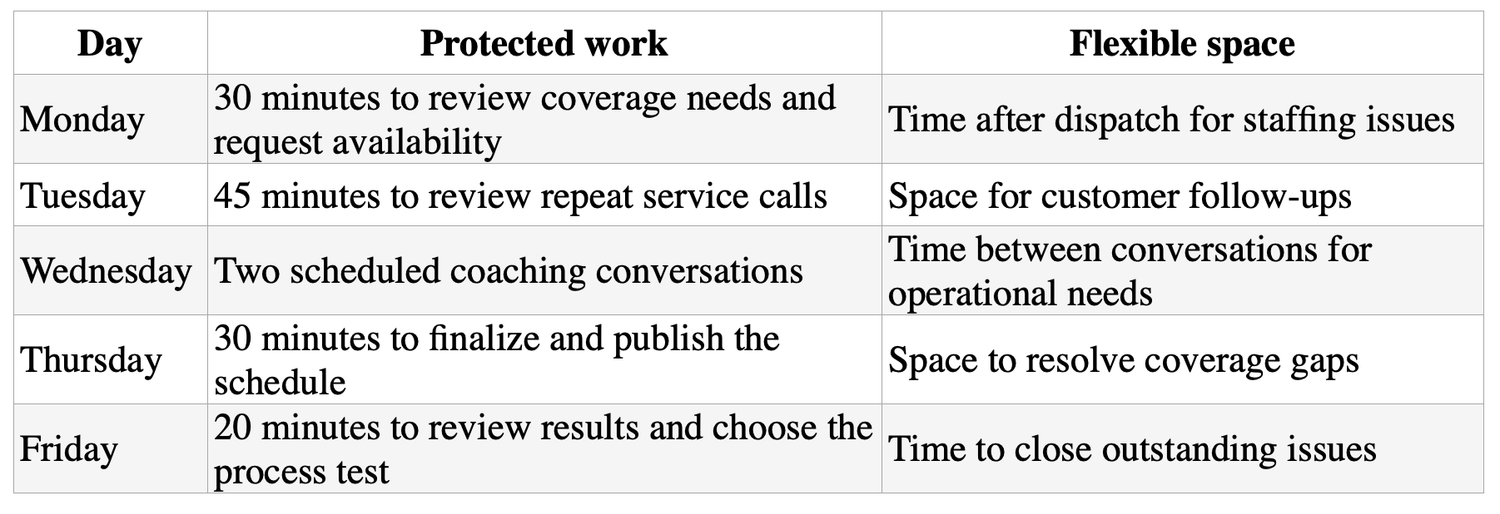
Daily service responsibilities continue throughout the week. These blocks give your chosen outcomes a place alongside them.
The plan also helps you respond when conditions change. If an urgent customer issue takes Tuesday’s review time, you can see what needs to be rescheduled.
5. Reset Your Priorities Each Day
Your weekly plan provides direction. A short daily review helps you adjust it.
Before the day gets busy, ask:
Which weekly priority needs progress today?
What is the next useful action?
Has anything changed that requires a different decision?
Keep the review brief. You are checking the plan against reality.
If a staffing emergency consumes the morning, decide what still fits in the afternoon. You may need to move a block, reduce the scope of a task, or ask for help.
A deliberate adjustment keeps the priority visible.
6. Review the Week Before Planning the Next One
At the end of the week, check your three outcomes.
What finished? What moved forward? What slipped—and why?
Be specific about the cause. The work may have been larger than expected. You may have needed information from someone else. You may also have allowed routine requests to displace time you intended to protect.
Each explanation points to a different adjustment.
Use what you learn to make next week more realistic. Over time, this review can help you spot recurring problems that deserve attention beyond your calendar.
Frequently Asked Questions About Weekly Planning for Managers
How many priorities should a manager choose each week?
Start with three meaningful outcomes. This gives you a manageable focus alongside routine responsibilities. If the week is unusually demanding, choose fewer or make the outcomes smaller.
When should managers plan their week?
Friday afternoon can help you close the current week and prepare for the next one. Monday before the operation gets busy can also work. Choose a time you can use consistently.
What if an urgent issue disrupts the plan?
Handle the issue, then review the affected commitments. Reschedule important work and communicate any changed expectations. If the same issue repeatedly disrupts your plan, consider making its underlying cause a future priority.
Make Next Week More Intentional
A useful weekly plan gives you a few clear outcomes and enough room to manage the people and problems in front of you.
Review your commitments. Choose three priorities. Put the first action for each into your calendar. Leave room to respond when the week changes.
Write your three priorities for next week and block time for the first one today.
RECENT POSTS